
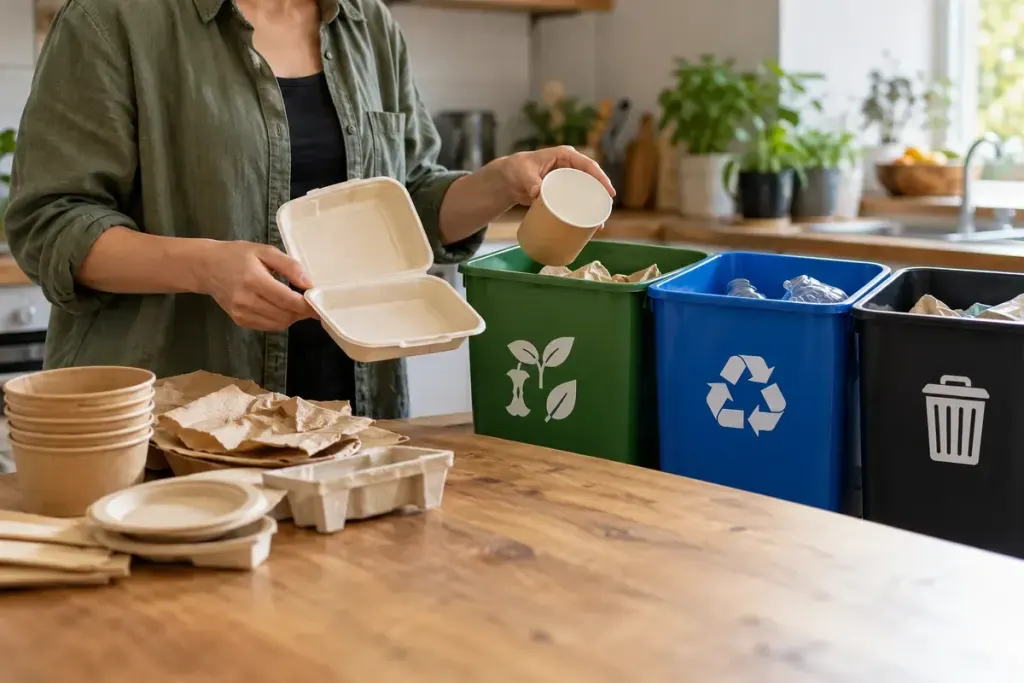
A takeaway container says compostable, but the food-waste collector does not accept it. That is not necessarily a contradiction: a material’s tested conditions and a local collection service’s rules are separate pieces of information.
Before choosing a bin, read the full claim. Does the packaging specify home composting, industrial composting or a particular certification? Check the lid, lining and label too; different components may have different instructions.
Conditions matter
The US Federal Trade Commission’s Green Guides explanation explains that compostability claims need context about suitable conditions and facility availability. Its guidance concerns US marketing claims, not a worldwide rule assigning packaging to a particular bin.
A home compost heap and a managed commercial process do not necessarily provide the same conditions. Do not assume packaging intended for one will break down appropriately in the other. “Plant-based,” “biodegradable” and “compostable” are also different claims; one word should not be substituted for another.
Ask the collector about the exact item
Use your local authority or waste provider’s current guidance. Some food-waste services accept food but exclude packaging, even when it carries a compostability claim. If the instructions are unclear, provide the material and certification details rather than asking only whether “eco packaging” is accepted.
Do not place it in conventional plastics recycling merely because it resembles plastic. Follow the collector’s instructions for the actual material. If there is no accepted composting route, ask how it should be disposed of locally rather than leaving it in the environment to break down.
For a cafe or event, choose packaging only after confirming the collection route available to customers or staff. A clear sorting sign should describe accepted items, not make a broad promise that every green-labelled container belongs together.
The useful question is where this specific item can go after use. A persuasive label becomes meaningful when the required process is available and the item actually reaches it.