
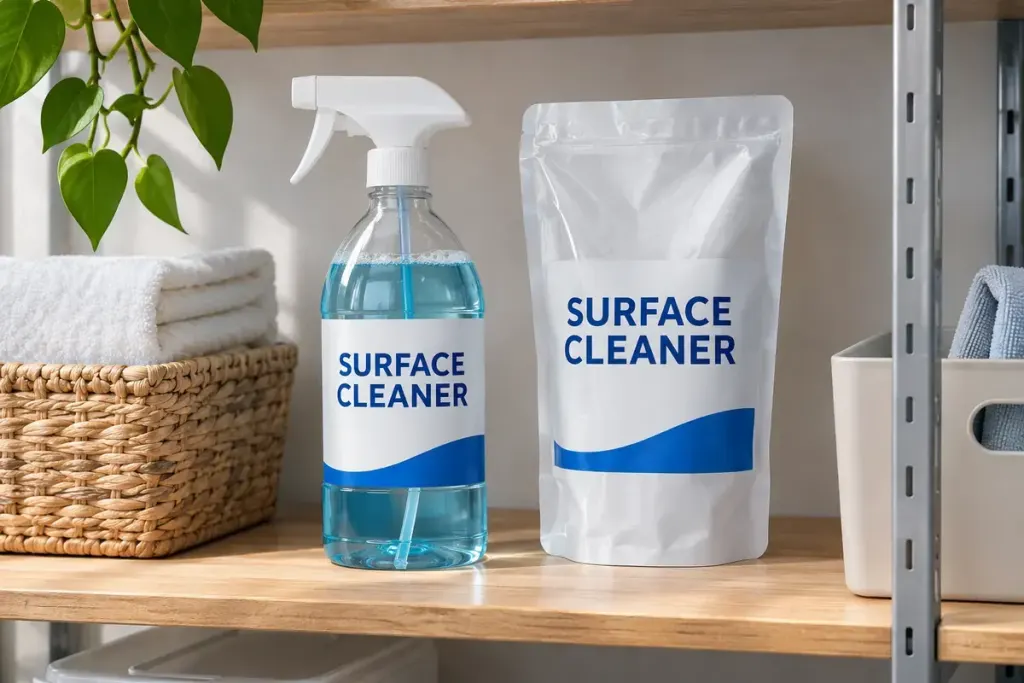
A reusable bottle only helps if it remains suitable for what goes inside. A decorative jar with no label may look tidy on a shelf while making a cleaning product harder to identify and easier to misuse.
Start with a refill system designed for the product. Use the manufacturer’s intended container and instructions, including any limit on reuse, cleaning method or replacement of a worn pump. “It fits through the opening” is not a compatibility test.
Keep the identity with the contents
The American Cleaning Institute’s guidance on decanting risks warns about transferring detergent products into decorative containers. Original labels carry directions and safety information, while suitable packaging helps reduce confusion.
Do not put cleaners into food or drink containers. Keep the product label legible and retain the refill package’s relevant instructions. If a label has become unreadable, obtain a suitable replacement through the product’s supported system rather than relying on memory.
A useful shelf arrangement puts refills beside their matching bottles while keeping incompatible products separate and everything stored as directed. This makes a wrong-bottle mistake less likely during an ordinary rushed chore.
Do not top up an unidentified mixture
Check that the remaining product is the same one the refill instructions permit. Never mix cleaning chemicals. A similar scent, colour or brand name is not enough to establish compatibility between different formulations.
If the system requires washing and drying before refilling, follow that process fully. Do not invent a universal rinse routine: some systems specify different preparation, and leftover water can alter a product. Use the actual instructions rather than advice for an unrelated cosmetic or food jar.
Inspect the cap, pump and bottle for cracks, leaks or damage. A reusable system still has components that can wear out. Replace an unsuitable container instead of keeping it in service simply to maintain a personal reuse target.
For comparing waste, record the number of successful refills and how the refill packaging is handled locally. A smaller package is not automatically accepted in the same recycling stream as the original bottle.
The practical goal is repeated, safe use with clear product identity. A modest refill routine that follows the manufacturer’s design is more useful than a perfectly coordinated shelf of unknown contents.