
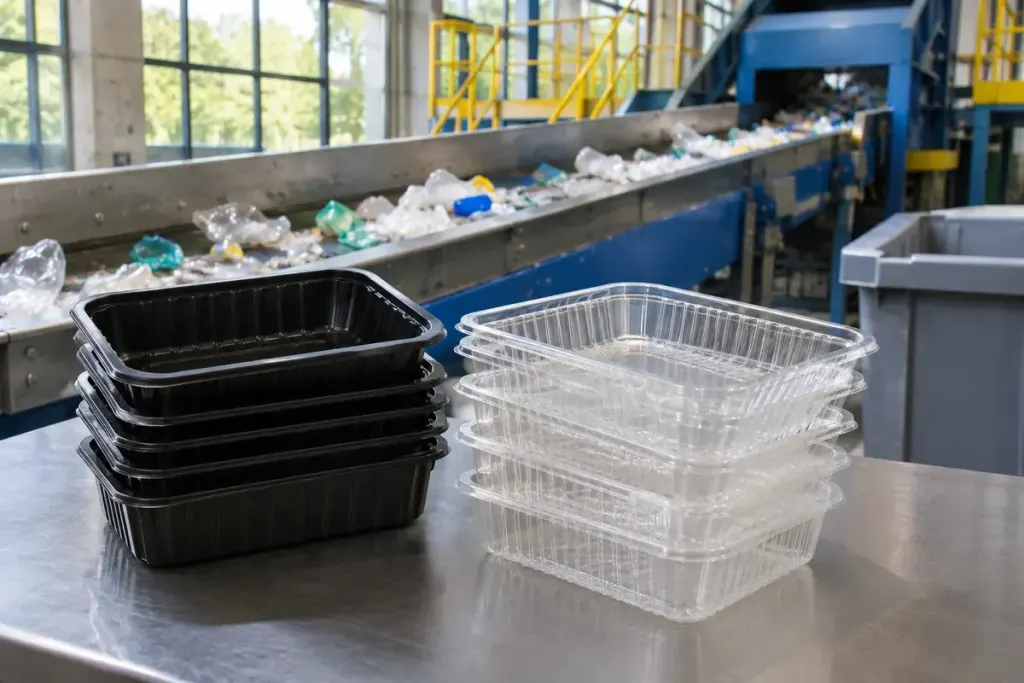
Two black food trays look almost identical, but a sorting system may not identify them equally well. Recycling depends not only on the underlying plastic but also on whether collection and processing equipment can recognise and handle the item.
WRAP’s black-plastic packaging resource explains the problem with conventional carbon-black pigmentation and near-infrared sorting, along with pigments designed to remain detectable. A black appearance does not tell a householder which pigment or sorting pathway a package uses.
Follow the chain rather than one material label
A package needs to be accepted in the collection system, sorted into an appropriate stream and processed through a viable recycling route. An improvement at one stage does not automatically establish that every local system accepts the item.
For a hypothetical comparison, one tray may use a detectable pigment while a visually similar tray does not. Without product information and local guidance, colour alone cannot distinguish them. Equally, the existence of newer detectable packaging does not make every older black tray detectable.
What to do with the item in your hand
Read the recycling instructions on the actual package and the current guidance from your local collection service. Check the container and any film lid separately, because they may have different instructions. Prepare the item as directed rather than adding an unfamiliar tray to the recycling in the hope that somebody will work it out later.
If the guidance is unclear, ask the collector about that packaging type and keep its answer with your household sorting notes. A photograph and the material information can make the question more precise than simply asking whether “plastic” is accepted.
When choosing between otherwise suitable products, packaging that your local system clearly accepts is easier to manage. Avoid treating a single colour change as proof of an overall environmental benefit without considering the whole package and its route after use.
The important distinction is between looking recyclable and being compatible with an actual system. Black-plastic sorting illustrates why material, pigment, equipment and local collection rules all belong in that assessment.