
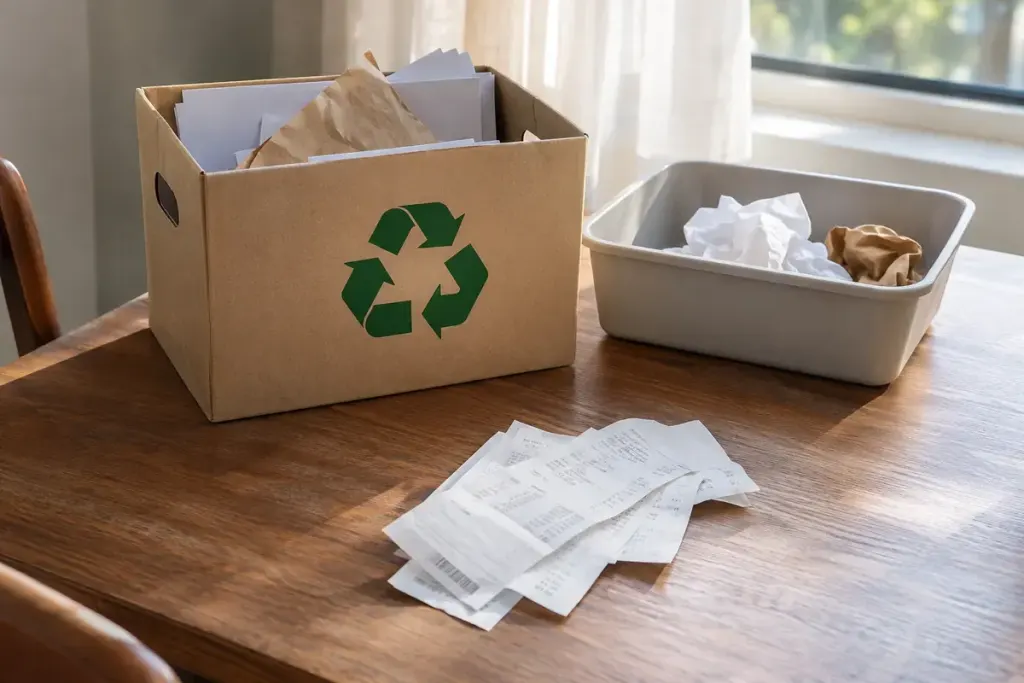
A receipt feels like paper, so the paper-recycling container seems an obvious destination. Thermal receipts complicate that shortcut. Their printing depends on a treated surface, and the collection route can differ from the one used for ordinary printed paper.
The practical answer starts with your local service’s item-specific guidance. A general statement that “paper is recyclable” does not establish what that service accepts as a thermal receipt.
Look up the item, not just the material
For example, Cornwall Council’s receipt guidance gives different collection instructions for standard paper receipts and thermal ones. That is a local instruction, not a sorting rule to copy into another area’s bins.
The UK Health and Safety Executive’s technical report on developers in thermal paper discusses the chemistry and processing of these materials. It helps explain why the word “paper” alone can miss a relevant distinction. It does not tell a household which container its own collector wants used.
Search the council or waste provider’s site for “thermal receipt” or “till receipt.” If the entry is unclear, ask the service rather than relying on a generic recycling symbol or a rule from another country. Newer receipt products and collection systems may not all follow the same route.
Separate the record from the scrap
Before disposal, decide whether the receipt is still needed for a return, warranty, expense claim or accounting record. Store necessary information in the form accepted by the relevant retailer or record-keeping requirement. A photograph can be useful, but it is not automatically a substitute for every original document.
When sorting a mixed wallet or drawer, keep receipts separate from ordinary letters until their route is known. Check the collector’s instructions about shredding as well; small fragments can have different handling requirements from intact sheets.
If a retailer offers a digital receipt, weigh convenience against sharing an email address and any marketing choices. You can often reduce the pile without accepting unrelated messages.
The aim is a repeatable household decision: keep the record if needed, identify the receipt type and use the local collection instruction. That is more reliable than turning a useful general recycling habit into a rule with no exceptions.