
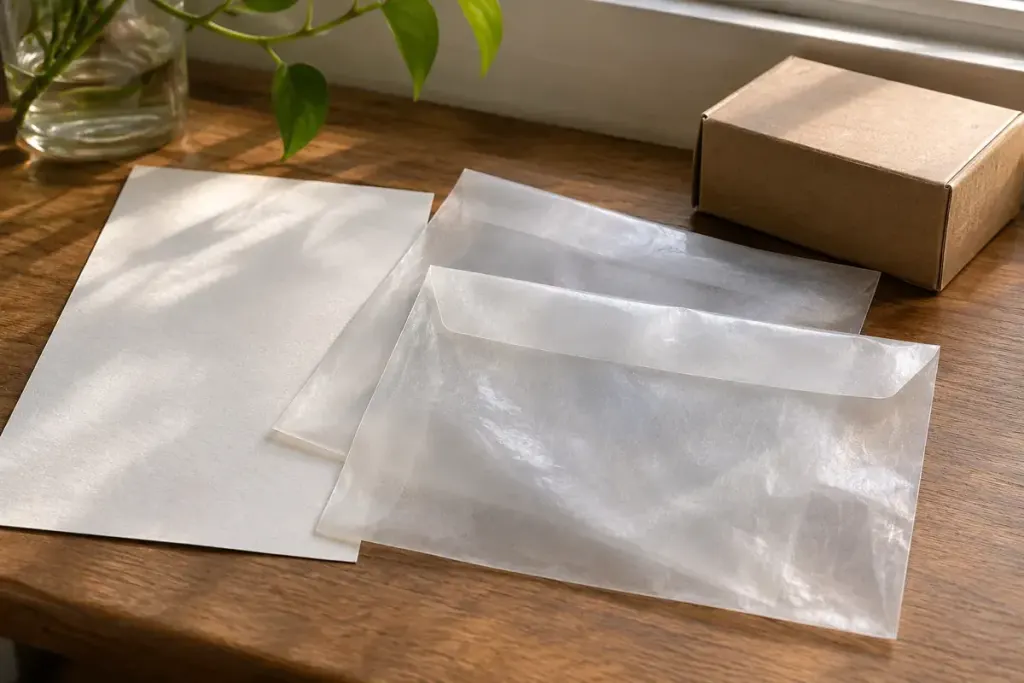
A smooth, translucent sheet inside a package can be difficult to identify. It may be glassine, a densely finished paper, rather than plastic film. Appearance alone is not enough to decide what it is or where it belongs after use.
The paper and the finished product are different questions
Glassine is associated with a smooth, dense finish produced through intensive calendering. A manufacturer’s specification can be much more informative than a photograph. For example, Sappi’s Silco Tape BS product specification describes a supercalendered release-base paper and the converting processes for which it is intended.
That distinction matters because a base paper may later receive silicone or another treatment. A claim about the paper before conversion does not automatically describe every finished label backing or wrapper made from it.
Look for the product’s own information
Check the packaging label, supplier description or manufacturer’s material guidance. Ask whether the item is uncoated glassine, a release liner or another composite. Words such as translucent, grease-resistant or recyclable need the context of the exact product and local collection system.
Do not burn a sample or use solvents to identify it. A supplier enquiry is safer and more reliable than a home test that may still leave the composition uncertain.
Reuse only for a suitable task
A clean sheet may be useful for an appropriate non-food task, such as separating some craft materials, if it will not damage them. Do not assume an unknown wrapper is food-safe, suitable for baking or appropriate for archival storage merely because it resembles a specialist paper.
Keep any original instructions with material saved for reuse. Once it is loose in a drawer, the difference between a known product and an unidentified sheet becomes easy to forget.
Check the local disposal route
Household paper collections and specialist release-liner schemes do not necessarily accept the same materials. Follow the instructions for your area and product rather than applying a universal rule based on the word “paper.” If the item is not clearly covered, ask the collector.
The useful habit is to identify the finished material first. That avoids both throwing away a suitable resource unnecessarily and putting an incompatible coated sheet into a stream that cannot process it.