
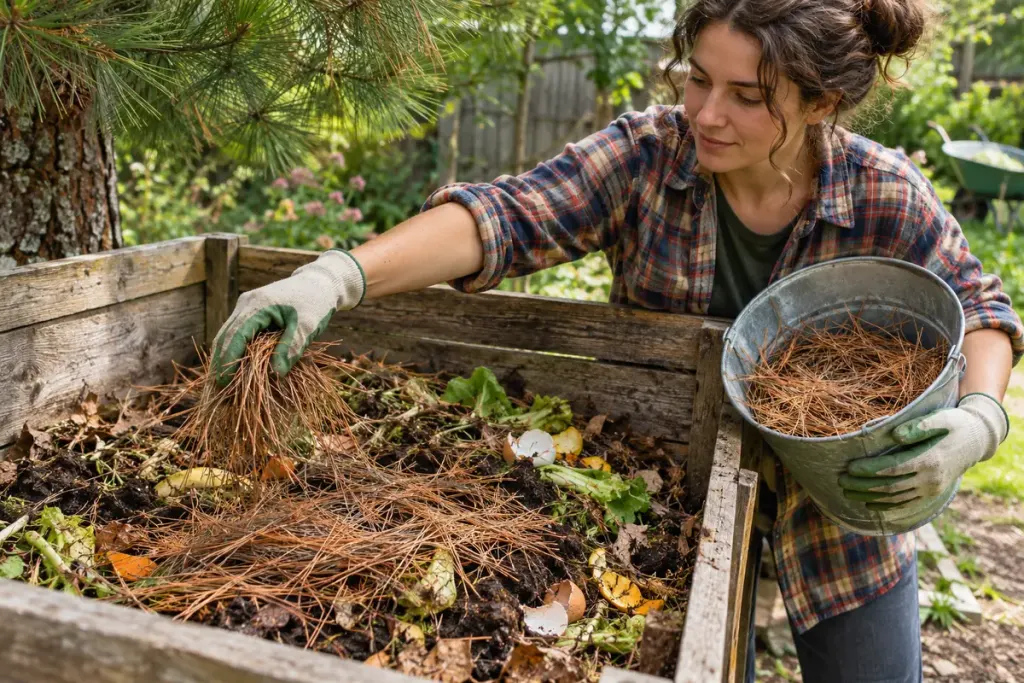
A layer of fallen pine needles often prompts the same question: will adding them to compost make the garden too acidic? The chemistry of fresh plant material is not a permanent label for the compost it eventually becomes.
Oregon State University Extension explains that acids in pine needles break down during decomposition and rejects the assumption that needle mulch necessarily acidifies the soil beneath it.
That does not mean a pile of needles instantly becomes finished compost. Their physical structure and the overall mixture still affect decomposition. Treat them as one ingredient in a varied pile, rather than the entire recipe.
Mix a modest addition through the pile
An Oregon Extension response about pine needles gives a conservative rule of thumb of no more than roughly a tenth of a compost pile. It is a practical mixing guide, not a laboratory prediction of the final pH.
For a household pile, add a small quantity alongside the other suitable materials you are already composting. Break up dense layers so that new material is distributed, and manage moisture and air according to your composting method.
If you collect several bags at once, there is no need to empty them all into a small bin. Keep some aside for later additions or consider an appropriate mulch use. The useful question is how much the pile can handle, not whether every needle must disappear immediately.
Use a test for a soil decision
Do not add lime merely because pine needles were included, and do not rely on needles alone to create the precise conditions an acid-loving plant needs. If pH matters to a planting decision, test the soil and follow locally appropriate advice.
Keep a simple note of the materials and quantities you added. When the compost matures, that record helps explain its behaviour more usefully than the presence of one recognisable ingredient. Decomposition changes materials; a gardening decision should account for the finished mixture and the soil receiving it.