
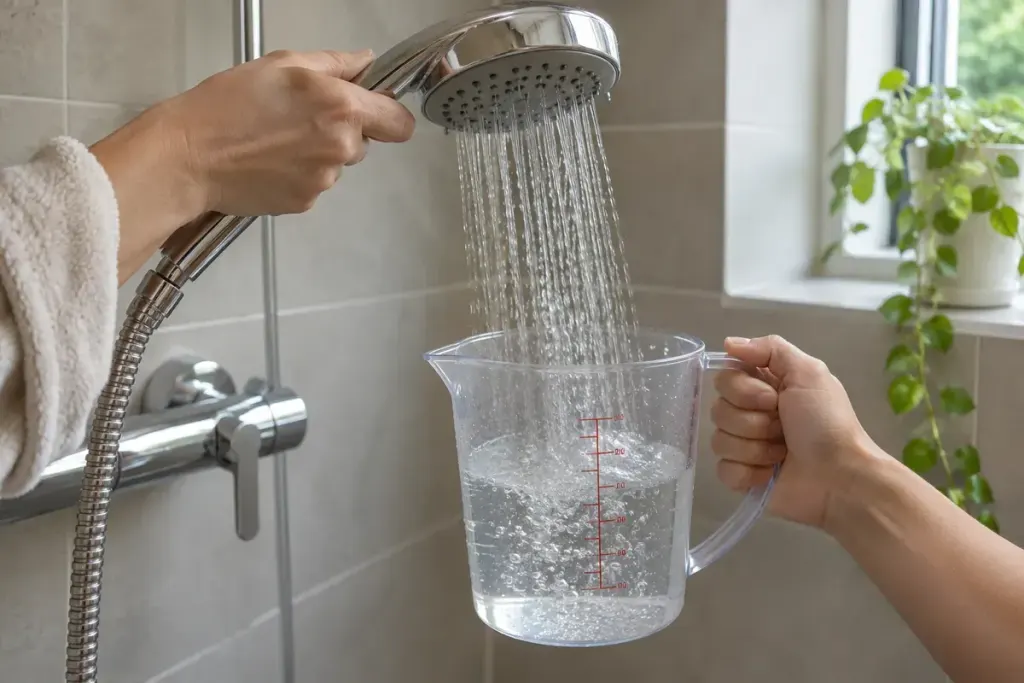
A shower can feel powerful without revealing how much water passes through it each minute. Measuring flow gives a more useful starting point than judging only by the sensation of the spray or the size of the showerhead.
The US EPA’s WaterSense showerhead guidance distinguishes water efficiency from performance requirements. A suitable efficient showerhead should be assessed as a functioning fixture, not simply as a device that makes the flow as small as possible.
Turn a short observation into a rate
Where it is safe and practical to collect the whole flow, use a suitable marked container and a timer. Keep the water at a safe temperature, the floor secure, and electrical items away. Do not balance an unstable heavy bucket or dismantle the fitting to complete the exercise.
Divide the collected litres by the elapsed seconds, then multiply by 60. For example, an illustrative collection of 1.5 litres in 10 seconds corresponds to 9 litres per minute. Repeat the observation under the same settings to see whether the result is reasonably consistent.
A container that misses part of a wide spray will undercount. If collection is awkward or unsafe, use the product’s rated flow information and seek appropriate advice rather than forcing a home test.
Add duration before claiming a saving
At a steady 9 litres per minute, an eight-minute shower uses about 72 litres during that period. At 7 litres per minute for the same duration, it would use about 56 litres. These are worked examples, not measurements of your bathroom, and they exclude any additional running time before or afterwards.
Changing the showerhead and doubling the time in the shower would change the comparison. Record both flow and duration if you want to understand your own routine.
Before replacing a fitting, check compatibility with the water-heating system and local requirements. Keep comfort and reliable temperature control in the decision. A useful measurement helps identify an appropriate change; it does not require accepting a shower that no longer works properly.