
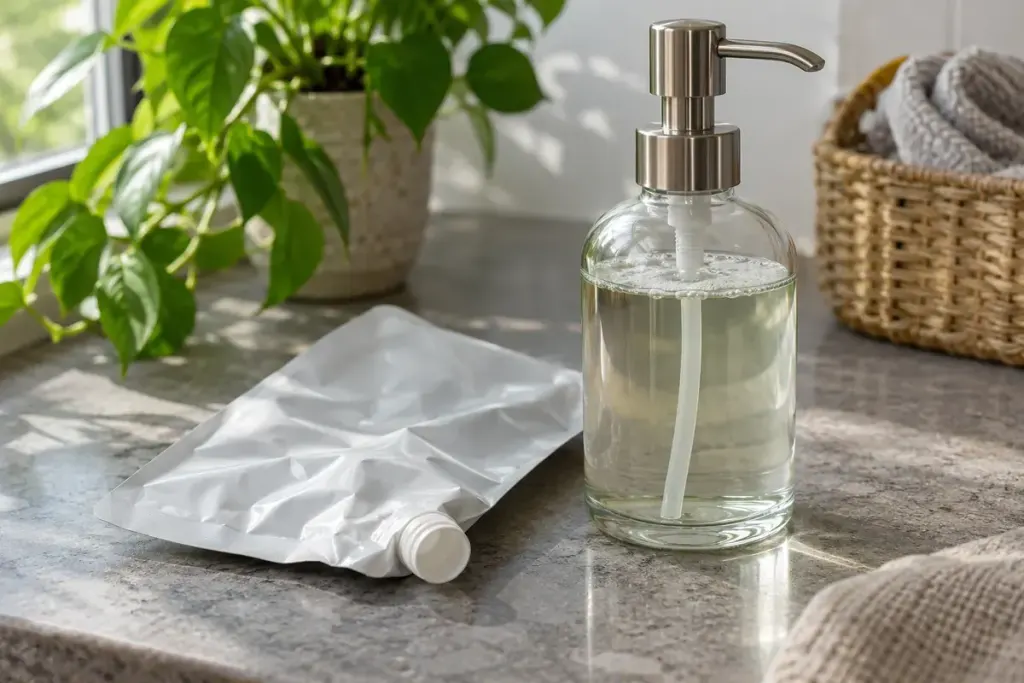
A lightweight refill pouch can reduce the packaging needed to deliver a product while still being awkward to recycle locally. Those observations are compatible. One concerns the quantity of material; the other concerns what can happen to it after use.
Keeping the questions separate helps when a large “less plastic” claim appears beside a much smaller disposal instruction. Neither the flexible feel of a pouch nor a picture of leaves tells you the whole story.
Compare equal amounts of usable product
For an illustrative comparison, imagine a 500 ml bottle whose empty packaging weighs 40 g and a 1 litre refill pouch weighing 15 g. Delivering 1 litre in two of those bottles would use 80 g of packaging, compared with 15 g for the refill. Those invented figures show how to compare like quantities; they are not measurements of any particular brand.
The calculation also does not measure the product’s complete environmental impact. Transport, production, how often the dispenser is reused, and wasted contents may matter. A concentrated refill needs a comparison based on the prepared product, not simply the volume printed on the pouch.
Find the actual collection route
In the UK, Recycle Now’s pouch guidance explains that certain baby-food, pet-food and detergent pouches can go to selected retailer collections for plastic bags and wrapping. That is not the same as saying every pouch belongs in every household recycling bin.
Check the instruction on the specific pack and the current rules of the collection point you will use. A scheme may accept some formats but exclude others. Local arrangements elsewhere can be different, so a recycling statement from another country is not enough.
For a practical household decision, ask two separate questions: does this refill reduce the packaging required for the amount I actually use, and can I follow its disposal instructions where I live? Also check that the refill is intended for your dispenser and follow the manufacturer’s cleaning and refilling directions.
You may still choose a pouch when the local end-of-life route is imperfect. The useful habit is to describe the benefit precisely rather than turning one material saving into a claim that the entire purchase is waste-free.