
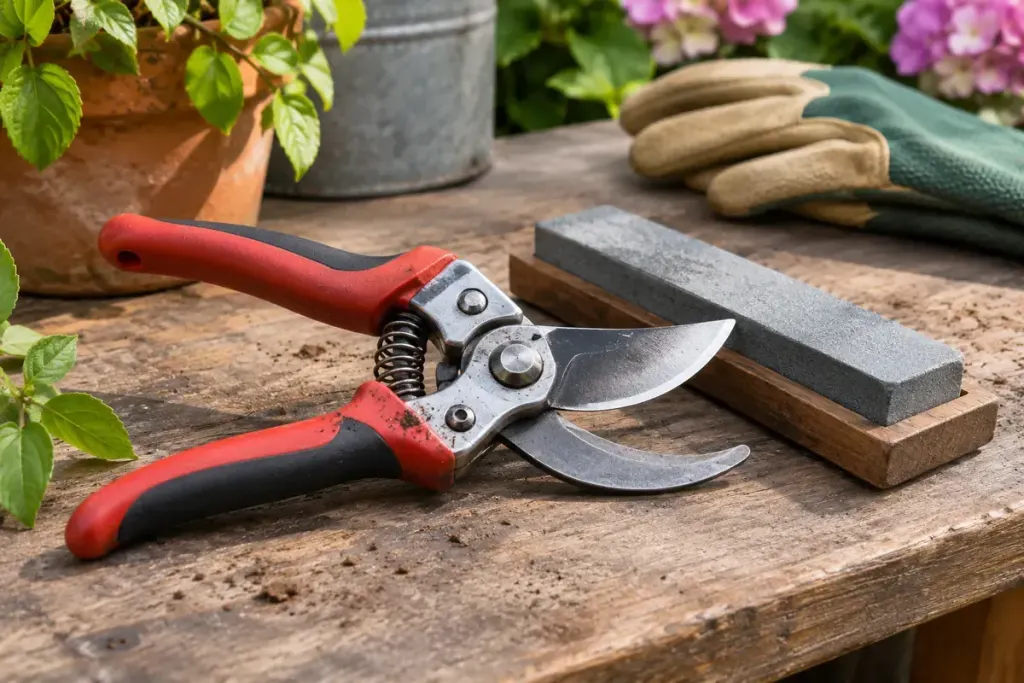
Secateurs that crush a stem can make replacement feel inevitable. Before discarding them, check whether the problem is a dull edge, accumulated residue, poor adjustment or actual damage. Those conditions call for different responses.
Inspect before sharpening
Clean the tool according to its instructions and look for chips, cracks, looseness and damaged handles. A broken component is not repaired by removing more metal from the blade. Keep powered equipment disconnected and use the manufacturer’s maintenance procedure.
The Royal Horticultural Society’s hand-tool sharpening guide explains that different tools and edges need suitable sharpening equipment. A bypass secateur, garden knife and spade should not all receive the same treatment simply because each has a metal edge.
Match the method to the blade
Identify the bevel and the manufacturer’s instructions before starting. Whetstones, diamond tools and files have different uses, and some stones require a particular lubricant. Avoid guessing an angle or reshaping the blade aggressively to make it look sharper.
If you cannot identify the correct edge or the tool is valuable, a repair or sharpening service may be a better first step. Asking for help can preserve more material than repeated experimental grinding.
Make the decision measurable
For your own maintenance notes, record the tool, the observed problem, the action and the result on an appropriate test material. “Cuts cleanly after cleaning and adjustment” is different from “sharpened until shiny”. Keep fingers clear of cutting edges and use suitable protection and a stable setup.
Do not test sharpness by running a finger along the blade. Reassemble and check the tool as directed before returning it to use.
Repair does not always mean keeping every part
A replaceable blade, spring or handle can sometimes extend the life of the tool. In other cases, severe damage makes replacement sensible. Check spare-part availability and compatibility rather than forcing a near match.
The low-waste choice is the one that restores safe, useful function. A maintenance habit—cleaning, drying, inspecting and storing properly—also reduces the chance that a serviceable tool will be discarded because its condition was allowed to deteriorate unnoticed.