
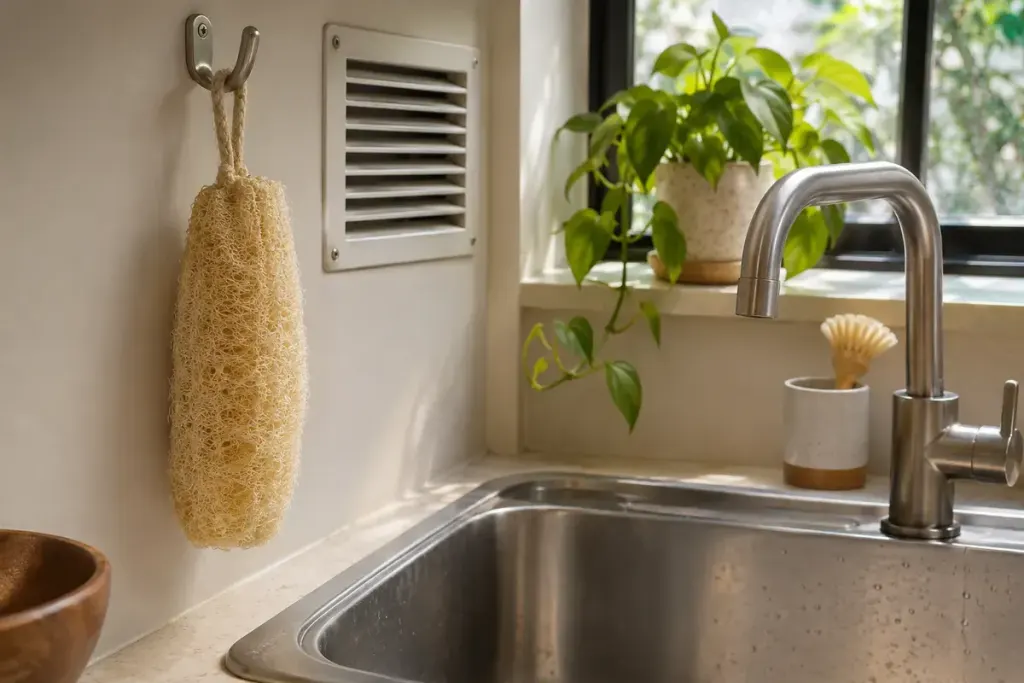
A natural loofah can make a kitchen sponge feel less disposable, but its plant origin does not remove the need for care. A useful reusable tool needs a place to dry, a cleaning routine suited to the product, and a clear point at which it is replaced.
Loofah is the fibrous interior of a mature gourd, not a sea sponge. Illinois Extension’s guide to growing loofah explains how the fruit develops into the familiar fibrous material.
Choose a job and a drying place together
Before adding a loofah to the sink, decide what you will use it for. Keep a kitchen tool separate from one used for personal washing or bathroom cleaning. Check whether its texture is appropriate for the surface; delicate coatings may require a softer tool.
A small household experiment could begin with a single loofah used only for an agreed washing-up task. Give it an open, draining place rather than leaving it in standing water or sealing it away while damp. Review whether that location actually allows it to dry between uses.
Follow care instructions for the complete product
A product sold as “natural” may also contain stitching, a hanging loop or other materials. Read the maker’s cleaning instructions before applying heat, chemicals or a machine-washing method. Advice for one construction may damage another.
After use, remove trapped debris and rinse as directed. Drying is part of maintenance, not proof that a tool has been disinfected. Continue to follow ordinary food-hygiene practices for the dishes, worktops and tasks involved.
Replacement is part of reuse
Inspect the tool as you clean it. Persistent odour, visible mould, deterioration or debris that cannot be removed are reasons to stop using it. Do not keep an unsuitable cleaning tool simply to meet an arbitrary zero-waste goal. Follow any replacement guidance supplied with it.
Check the final destination
If you plan to compost a worn-out loofah, confirm the materials and what your own composting system or local collection accepts. Remove incompatible additions where appropriate. “Plant-based” on the label does not answer every disposal question.
The worthwhile habit is a complete one: select carefully, use for a defined job, maintain properly and replace responsibly. That makes the material choice part of a working household routine.