
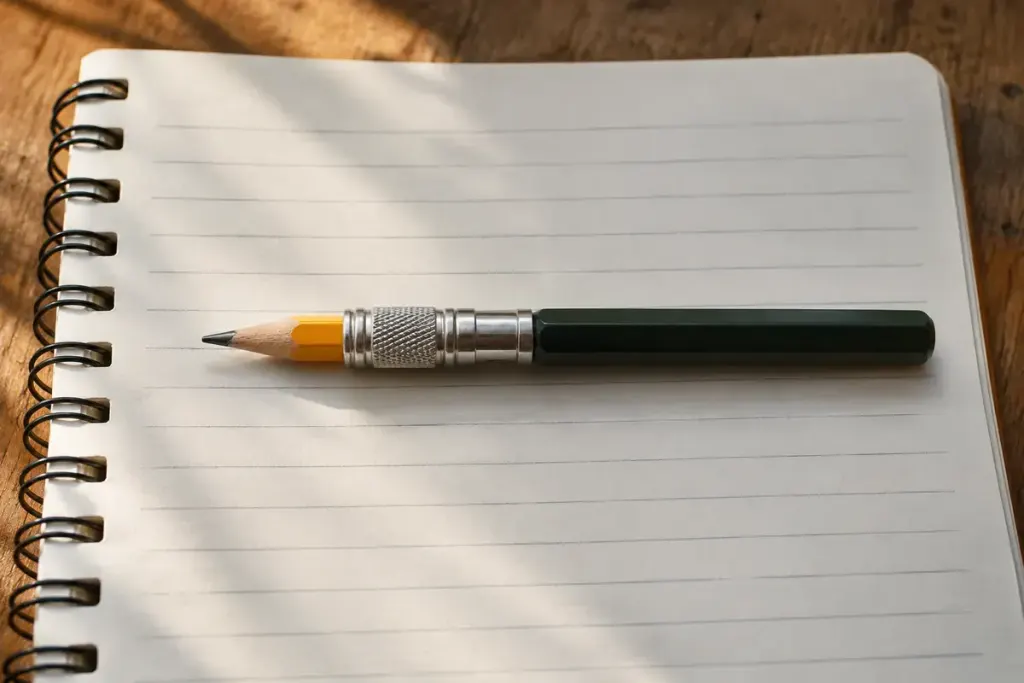
A pencil can still contain useful graphite when its wooden body has become awkward to hold. A pencil extender offers a small, practical answer: it grips the remaining stump and supplies a longer handle.
The useful question is whether it fits the pencils you actually use. Round, hexagonal and thicker artist’s pencils do not all share one diameter. An extender that looks right in a photograph may clamp poorly around a particular barrel.
Test the fit with an ordinary writing task
Follow the holder’s fastening method and insert enough of the pencil for a secure grip. Tighten gently. The aim is to stop slipping, not to crush the wood or force an unsuitable pencil into a narrow opening.
Write a shopping list or shade a small patch on scrap paper. Does the pencil rotate inside the holder? Does the join press into your fingers? Can you see the point clearly without moving your hand into an uncomfortable position?
If it keeps slipping, check for the correct fit rather than adding permanent glue. A removable pencil is easier to sharpen, inspect and replace. Stop using a holder that has a cracked collar or a sharp edge where your fingers rest.
Give the short pencils one place to wait
A small tray beside the sharpener can keep usable stumps from disappearing into the waste bin. Separate pencils with sound wood from pieces whose casing has split. Keep the tray modest: a growing collection of unusable fragments does not become more useful simply because it is saved.
Remove the pencil from the extender before sharpening unless its instructions specifically allow another arrangement. Put it back, check that the point is firm and continue with a real task.
An extender is most worthwhile when it solves a recurring problem at your desk. If you rarely reach the awkward last part of a pencil, use what you already have first. The purpose is to extend the life of a familiar tool, not to create a new drawer of accessories.