
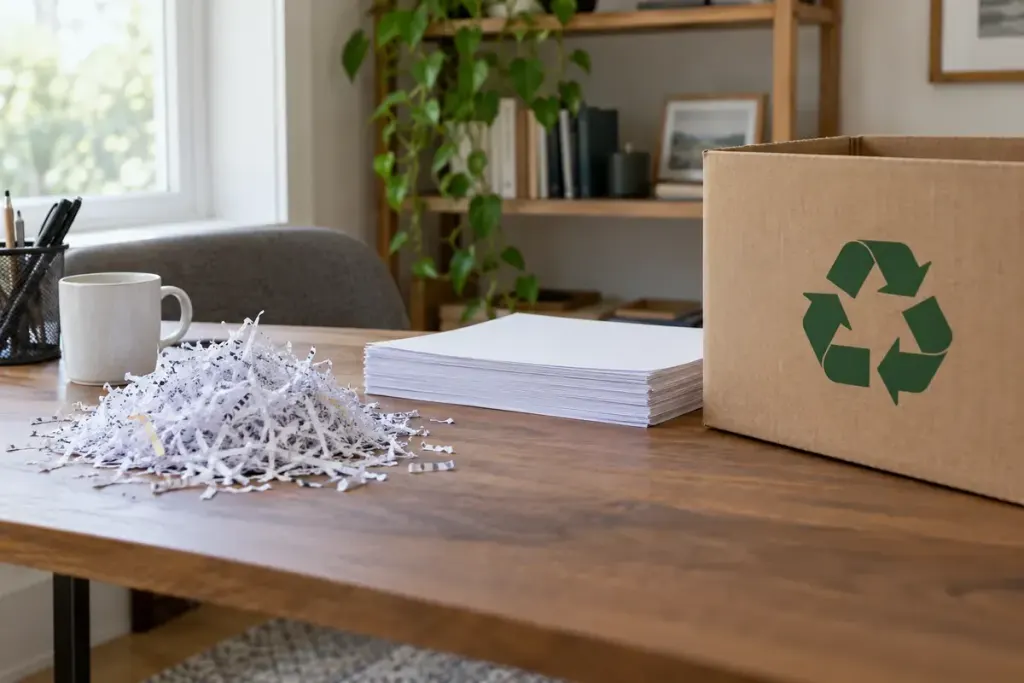
Paper can be recyclable while shredded paper is excluded from a particular collection. Small pieces behave differently in sorting equipment, and collection rules depend on the system that will handle them.
For example, Portland’s recycling guidance explains that shredded paper does not belong in its home recycling bin and points residents towards a separate option. In contrast, Recycle BC lists shredded paper with specific containment instructions. Neither example should be treated as the rule for every town.
Search for the exact material
Use your collection provider’s guidance for “shredded paper,” not just its general paper category. Check whether it accepts the material at the kerbside, at a depot or through a separate service. Read the preparation instructions as carefully as the yes-or-no answer.
In an illustrative household note, record the provider, accepted route and required container. Add the date you checked. This turns a one-off search into a useful reminder without assuming the arrangement will remain unchanged forever.
Do not improvise the packaging
A plastic bag, paper bag or loose pile may be treated differently by different systems. Use the specified method rather than choosing whichever seems tidiest. Keep the paper dry and avoid mixing it with unrelated waste unless the provider expressly says otherwise.
If the website is unclear, ask the operator before adding a large quantity to the bin. A short question about the exact material is more useful than an assumption based on the recycling symbol printed on a container.
Balance recycling with information security
Do not leave confidential documents intact solely to simplify recycling. Use an appropriate destruction method, then find a collection route that accepts the resulting material. For sensitive business records, an authorised document-destruction service may have its own handling and recycling arrangements.
The practical sequence is to protect the information first and follow the local material instructions second. A familiar material name does not guarantee that every physical form belongs in the same bin.