
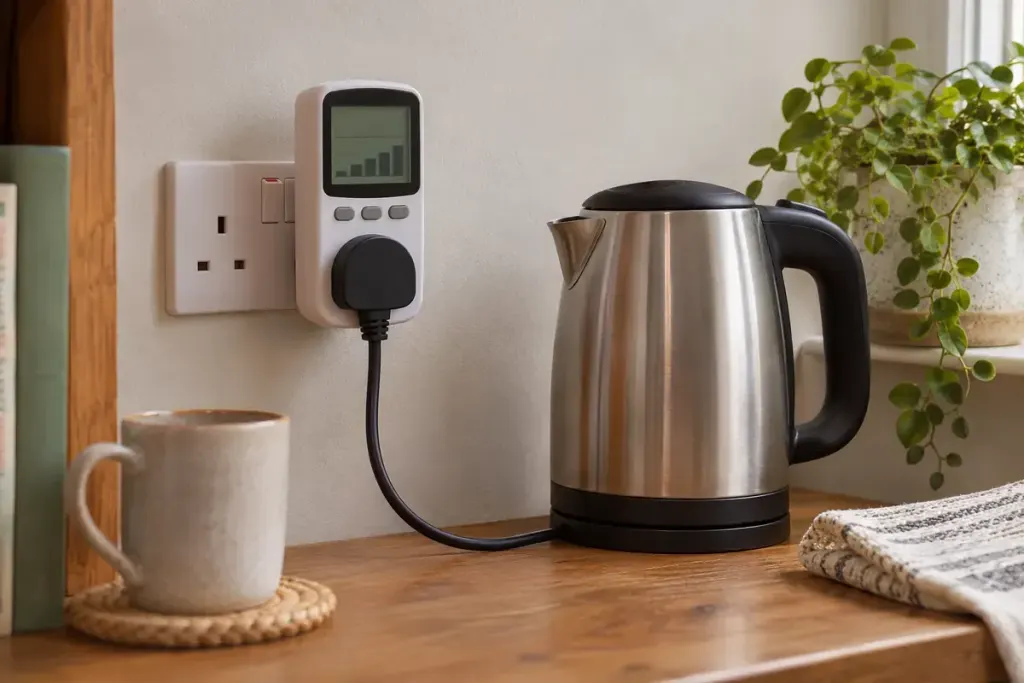
A plug-in meter briefly shows zero, then a small number, then zero again. That does not necessarily mean the appliance uses no energy while waiting. Some devices cycle through background tasks, and a meter also has limits to what it can resolve at very low loads.
The US Department of Energy’s guidance on measuring standby power explains why the operating state and measurement method matter. A representative observation period can be more informative than a single glance at the display.
Keep power and energy separate
Watts describe the rate of energy use at a moment or an average over a measurement interval. Kilowatt-hours describe accumulated energy. A compatible meter that records energy over time can help show what happens across a typical waiting period.
As a deliberately simplified example, a device averaging 2 watts for 20 hours each day would use 14.6 kilowatt-hours over 365 days in that state. The calculation is 2 × 20 × 365 ÷ 1,000. This is not an estimate for your appliance; use its measured behaviour and your own tariff to assess cost.
Check whether “off”, “standby” and “network standby” are different states on the product. Some simple appliances may draw no measurable power when switched off, while others retain displays or connected functions. A kettle in a photograph is not evidence that every kettle has a standby load.
Measure within the equipment’s limits
Use a reputable plug-in monitor compatible with the supply and appliance, within its stated current and power ratings. Follow its instructions and keep it dry. Do not open electrical fittings, modify wiring or use an ordinary plug-in meter on a load it is not designed to measure.
Record the appliance mode, start and end times, accumulated energy and any interruptions. Repeat if the first period was unusual. A firmware update or a different usage pattern can make one evening unrepresentative.
Before switching something off routinely, check what depends on it. Refrigeration, medical equipment, security systems and network services can have functions that should remain active. The manufacturer’s instructions and household needs take priority over eliminating every small reading.
Use the results to choose a few practical changes you can sustain. Measurement is most useful when it replaces assumptions with a realistic account of which devices consume energy, when they do it and what can sensibly change.