
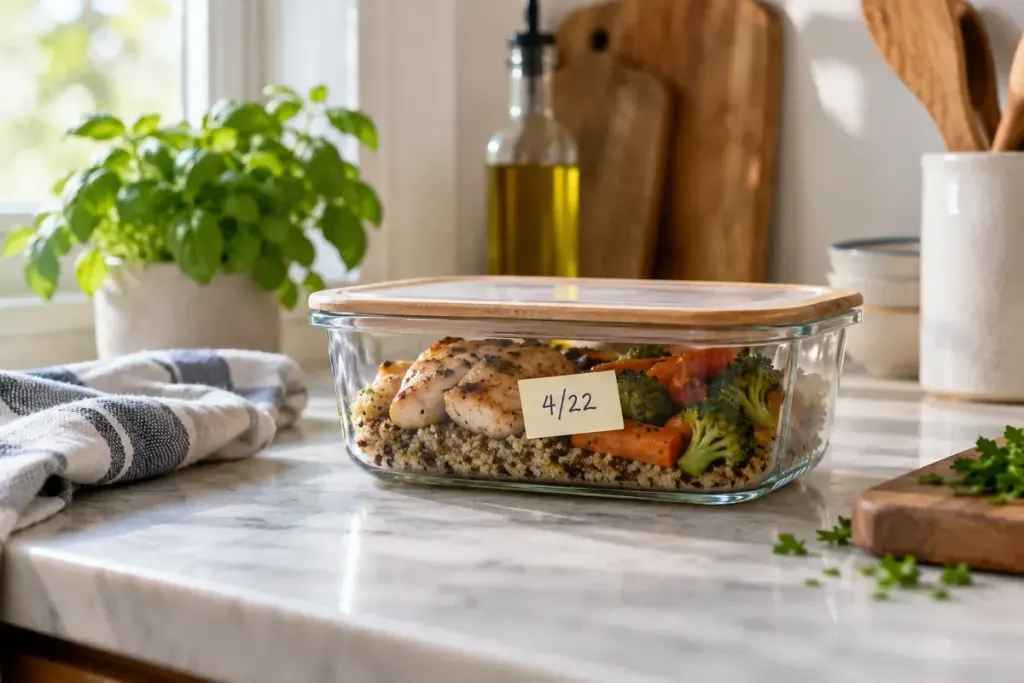
A container at the back of the fridge looks familiar, but nobody remembers whether it was cooked yesterday or several days ago. A small date label is more useful than a confident guess.
Write what the date means
Label the food and the date it was cooked or prepared, using an unambiguous format. If you later freeze it, record that separately. A bare number can be mistaken for a freezing date, a use-by instruction or the day the container was washed.
For an invented household label, “Vegetable stew — cooked 21 October; frozen 22 October” preserves the sequence. The dates alone do not establish safety; the food still needs appropriate cooling, storage and handling throughout.
Put safe storage before the label
USDA’s leftovers guidance recommends prompt refrigeration and gives a general refrigerated storage period of three to four days for leftovers. It also explains the two-hour limit at room temperature, reduced to one hour above 90°F. Follow food-specific and local guidance where it is stricter or different; these are not universal extensions for every dish.
Use suitable shallow containers and a refrigerator maintained at the recommended temperature. Do not leave a large pot on the counter for hours while waiting for it to become completely cold. A neat label cannot undo unsafe cooling.
Make the next meal visible
- Keep labelled containers where household members can see them.
- Choose a portion you can use within its safe storage period.
- Freeze suitable food promptly if you will not use it in time.
- Discard food when its safety is uncertain; do not taste it to decide.
Reheating or transferring leftovers into a new container does not make their earlier history disappear. Keep the original preparation information attached to the food rather than replacing it with today’s date.
Reducing waste begins with a realistic portion and storage plan. A clear label supports that plan by answering the ordinary question that so often stops it: what is this, and when did we make it?