
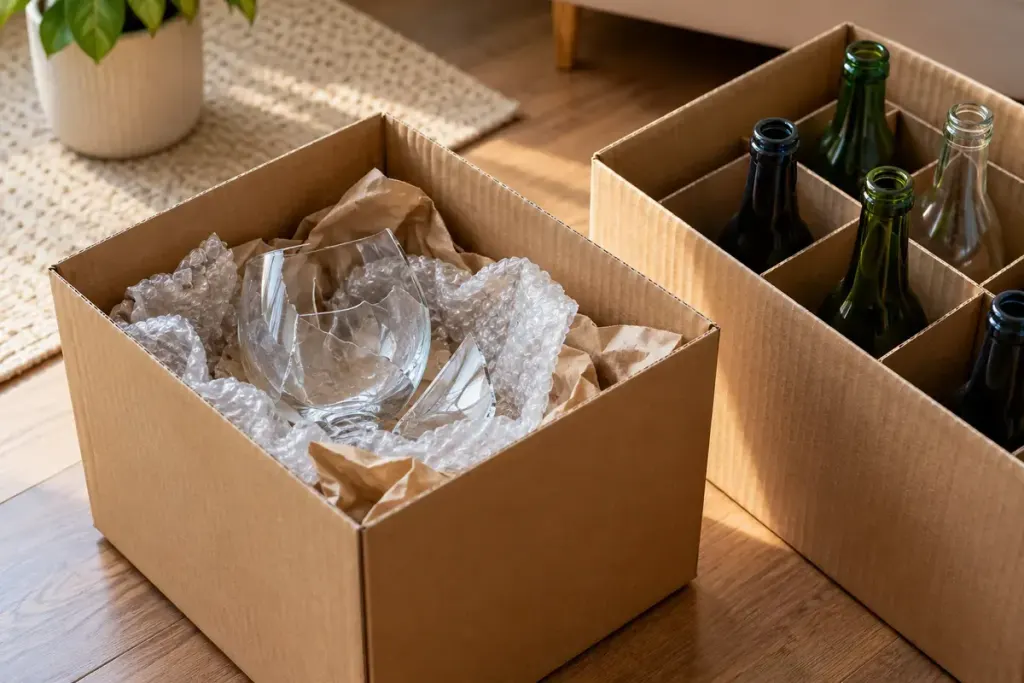
A tumbler breaks beside an empty sauce jar, and it seems logical to place both in the glass recycling. Their shared appearance does not mean the collection system accepts them together.
The UK service Recycle Now distinguishes drinking glasses from bottles and jars and advises against putting drinking glasses into the home glass collection. Its guidance is a useful example of why the item type matters; your local authority or collection provider determines the route available where you live.
Identify the object before the material
Search the local waste guide for “drinking glass” or “tumbler”, not just “glass”. Ovenware, mirrors, bulbs and packaging can have different instructions even when they all look glass-like.
Read whether the guidance concerns kerbside collection, a bottle bank or a staffed recycling centre. An item accepted at one facility is not automatically accepted in the household bin.
If the guide is unclear, ask the provider using a description of the object. Do not add it to recycling on the assumption that the sorting team will decide; a wrong item can create both processing and handling problems.
Protect the next person who handles it
Keep people and pets away while dealing with broken pieces, and use suitable protective equipment and tools rather than bare hands. Follow the local instructions for safe containment and disposal. Recycle Now advises wrapping broken drinking glasses safely before the appropriate non-recyclable waste route.
Do not leave loose shards in an open bag or mix them into a box of reusable items. If an intact set is no longer wanted, check whether a local reuse organisation accepts it; damaged items should not be presented as safe donations.
Save the local guidance with the collection details for your household. The useful habit is to sort by the actual accepted category, not by appearance alone. That makes the next broken glass a straightforward disposal decision rather than a guess.