
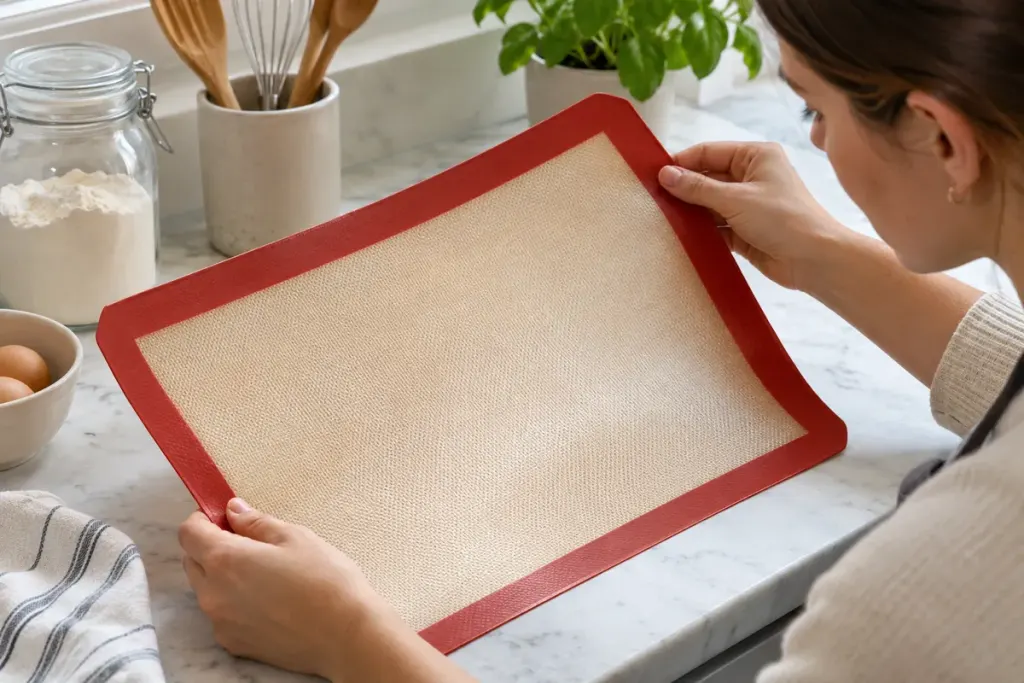
A reusable baking mat can reduce the need for some disposable liners, but “reusable” is a condition of use, not a promise that the mat stays suitable forever. Its surface and construction need to remain intact.
Before putting it back in the oven, give it the same quick attention you would give any other food-contact tool.
Do not make the mat fit with scissors
The Silpat manufacturer’s brochure says not to cut on its mats and not to use a cut or torn mat. It also supplies care directions for that product. Other products require their own instructions, especially where their construction differs.
Choose a size intended for the tray. A mat that buckles because it is too large can interfere with a level baking surface; trimming a reinforced mat is not an appropriate shortcut.
Inspect after cleaning
Look for cuts, tears, exposed reinforcement or deterioration. A stain and a structural defect are not necessarily the same thing, but uncertainty about damage is a reason to check with the maker rather than continuing automatically.
Use the recommended cleaning method and avoid sharp scraping tools. Dry and store the mat as directed, without a fold or storage arrangement the manufacturer prohibits.
Match the tool to the task
Check temperature limits and restrictions on use near heating elements, under a grill or with other heat sources. Being oven-safe under stated conditions does not make a product safe for every cooking method.
For an illustrative kitchen routine, keep the mat’s model or packaging instructions in a small household record. That makes it easier to verify the limits later, when the original label is no longer attached.
Do not assume silicone mats can be put in ordinary household recycling. Local collection systems and manufacturer schemes differ.
A lower-waste habit includes maintaining equipment well and replacing it when it no longer meets its intended condition. Keeping a damaged mat in service merely to avoid discarding it confuses longevity with suitability.